


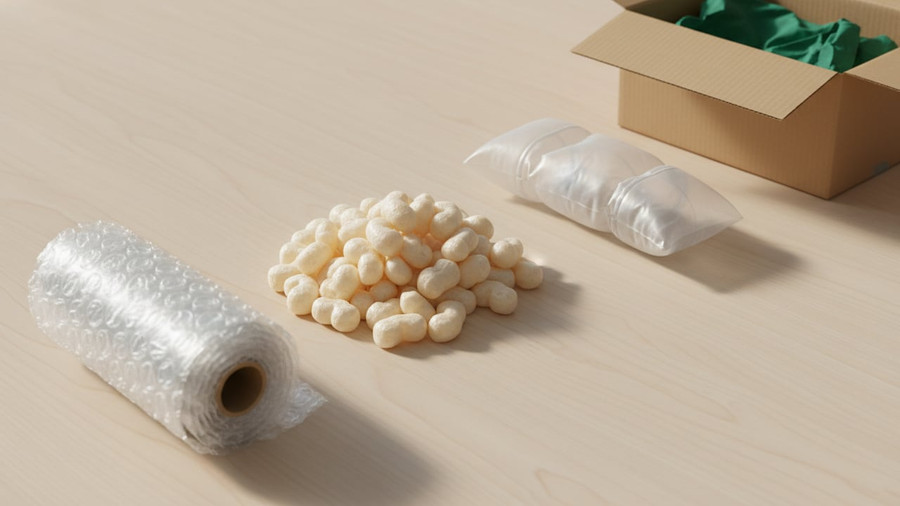
Bubble Wrap vs. Foam Peanuts vs. Air Pillows — Which Void Fill Wins?
Posted by David Chen on 22nd May 2026
Void fill keeps your product from shifting and absorbs the bumps of transit, but the three most common options behave very differently. Bubble wrap, foam peanuts, and air pillows each win in specific situations — picking the wrong one means either damaged goods or wasted money. Here's how they actually compare.
Bubble Wrap — Surface Protection
Bubble wrap wraps directly around an item, cushioning the surface itself rather than just filling space. It excels at protecting finishes, edges, and fragile faces.
- Best for: electronics, glass, framed art, anything with a vulnerable surface.
- Bubble size matters: 3/16" small bubble for light/scratch protection; 1/2" large bubble for shock absorption on heavier items.
- Downside: bulky to store, and it cushions the surface but doesn't immobilize an item inside a roomy box on its own.
Foam Peanuts — Loose Fill
Peanuts flow around irregular shapes and fill every gap, distributing pressure across the whole load.
- Best for: odd-shaped items, multi-item boxes, double-boxing fills.
- Choose biodegradable (starch-based) over polystyrene — they dissolve in water and avoid the static-cling mess.
- Downside: they settle in transit, so heavy items can migrate to the bottom and hit the wall. Pack tightly and never under-fill.
Air Pillows — Cheap Space Filler
Air pillows are inflated on demand and are mostly air, making them the lightest and most space-efficient fill to store (shipped flat, inflated when needed).
- Best for: filling void around an already-boxed or durable item; e-commerce blocking and bracing.
- Lowest DIM-weight impact of the three — they add almost no weight.
- Downside: poor surface protection and they deflate if punctured by sharp edges. Not a cushion for fragile faces.
Side-by-Side
- Surface protection: Bubble wrap > Peanuts > Air pillows.
- Fills irregular gaps: Peanuts > Air pillows > Bubble wrap.
- Storage footprint & weight: Air pillows > Bubble wrap > Peanuts.
- Cost per box filled: Air pillows are usually cheapest, peanuts mid, bubble wrap highest.
The Practical Answer
Most operations use a combination: bubble wrap around the item for surface protection, then air pillows or peanuts to immobilize it in the box. If you ship one product type, optimize for it; if you ship everything, stock air pillows for general void and bubble wrap for the fragile minority. Match the material to the failure mode you're actually seeing in returns.